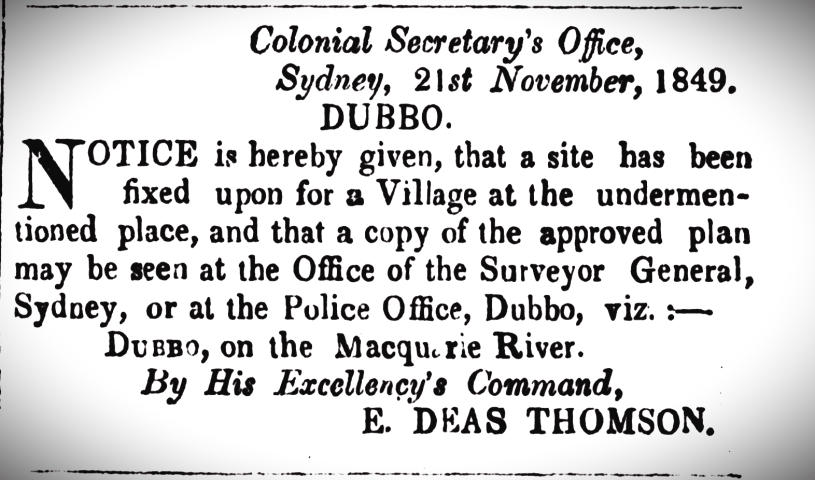
In 1849, 175 years ago, Dubbo Village was granted a ‘site’ by the Colonial Secretary of the day, Scotsman E. Deas Thomson. This was done at the behest of Jean Emile Serisier and associates. It was also still a time when Terra Nullius was a genuine belief, that the Wiradjuri Nation was “nobody’s land”. It’s a premise upon which colonialism globally operates in its thirst for wealth and power, to the detriment of the people whose land it actually is.
In the spirit of reconciliation this website acknowledges the Traditional Custodians of Country in the Wiradjuri Nation and throughout Australia and their connections to land, sea and community. Respect is paid to their Elders past and present and by extension, to all Aboriginal and Torres Strait Islander peoples today.
The King of Dubbo website aims to document the life of French colonial immigrant Jean Emile Serisier and his role as a founder of the city of Dubbo. The site name refers to a King because of the regard held for him by his European counterparts, and a reference describing as such was discovered in research.
Being French, also set him apart from British rule, and despite his own government following the same emperial path, Jean Emile’s French heritage most certainly shaped his view of the world and of the First Nations people found living in the Wiradjuri Nation but which he would have first known it as, Nouvelles Galles Du Sud (New South Wales),
There are clues throughout his life he sought equality for all, and by the time his last daughter was born, he rejected conventional naming norms, calling her Eumalga, the name of a Wiradjuri Chieftan’s daughter from the Wellington region.

Portrait of Edward Deas Thomson, Colonial Secretary, by William Nicholas, 1847-1848, from Baker, W. (1847). Heads of the People: An Illustrated Journal of Literature, Whims, and Oddities, State Library of New South Wales, Q059
The founding of present-day City of Dubbo
On 21 November Colonial Secretary E. Deas Thomson gave notice that a site had been fixed upon for the establishment of the village of Dubbo. The notice would appear two days later in the NSW Government Gazette on 23 November advising that plans for the village could be seen at the Office of the Surveyor General in Sydney or at the Police Office [sic] in Dubbo, on the Macquarie River.
Today, the city commemorates Dubbo’s gazettal each year on 23 November, known as Dubbo Day.
The plans and approval however came much earlier in the year, as the original plans drawn up by Captain George Boyle White suggest.
It says the plan was laid before the executive council on 2 July 1849 and again on 28 August 1849.
Approval was conveyed by the Colonial Secretary in a letter on 20 September 1849, which appeared in the Government Gazette two months later.
Before officiating a Dubbo village, a Dubbo police ‘lock up’ already existed, and pasturage licences had been issued three years earlier, giving permission to folk like British gentleman R.V. Dulhunty to run his stock Beyond the Limits of Location, the name given to a region outside the New South Wales Government controlled 19 counties, beyond the very edge of British colonial rule and deep in the heart of the Wiradjuri Nation.
A Frenchman set out to change that.

Credit: Archives Collections, Museums of History NSW, Western Sydney Records Centre
 King of Dubbo