
 The title Le Negociant is just one in a long, long list of possibles. It’s an easy enough element of a book to get hung up on. No different to naming a magazine, like Vogue or Time. In the long run, it will be synonymous with something it is trying to represent and like the cover of a magazine, it is the book’s advertisement.
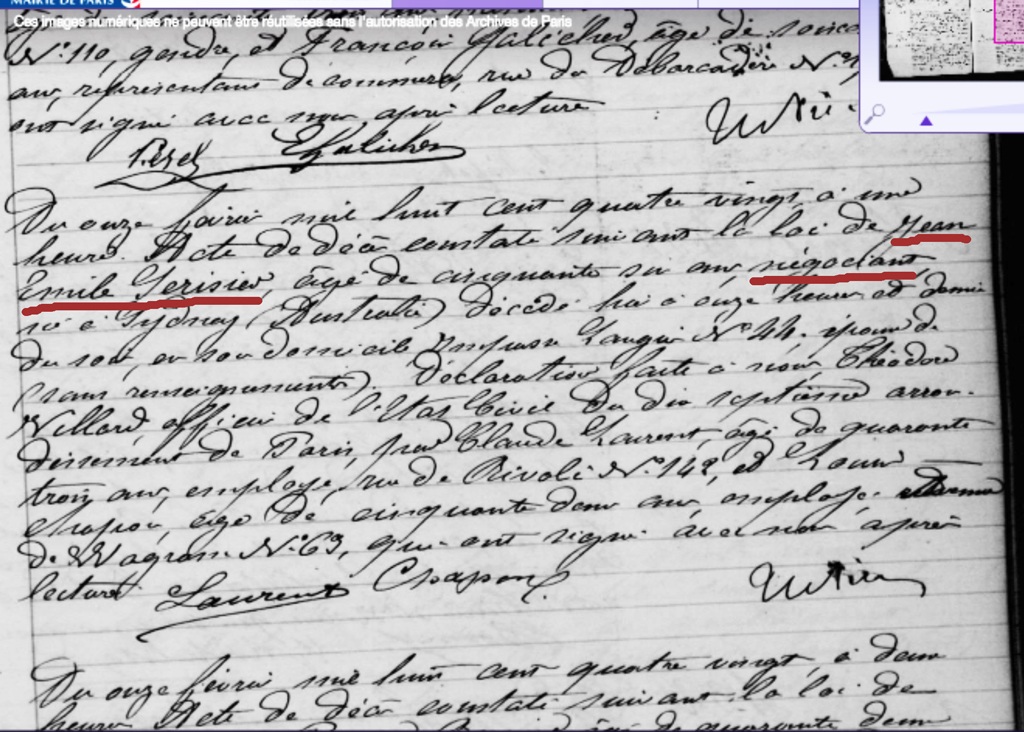
I could rant ad infinitum about that subject but for now to explain, the name came to me when I had successfully scoured an online archive in France, from my home at the time in rural New South Wales, Australia. Navigating I found, probably more through dumb luck than anything else, an online, hand-written book, dated in the vicinity of February (Fevriere) 1880, the month Jean Emile Seriser died in Paris.
How excited to have nailed one document in a sea of millions half way around the world embedded on a server in France, with the answer to burning questions: when, how and why? In the space of an hour I had turned the digital pages on a book written by a clerk of Paris whose job it was to record deaths. The details inside were like finding little grains of gold in a river of information, including an address where he is said to have passed away. Not clearly legible I spent some time, searching on Google Maps for anything similar until I found what I believe to be the address, and thanks to Google Maps and a link to a photo on Flikr, I could stand virtually on the street and stare up at the windows, look about at the street lanes. That in itself was strange because I felt like a ghost from the future looking in at Jean’s life in the distant past.
‘Standing’ there, I could hear the street sounds from that night and wonder what it might have been like, as Jean Emile shivered in his fevered last moments, his son, Hippolyte Paulin Macquarie, grieving at his side. February. It would have been cold, perhaps snowing. Passers by would be dressed in their winter clothes and coats. From what I can tell he died around 1 in the morning so the streets would possibly be quiet but people would have been about, including the undertaker if his body was removed immediately.
I wonder too was it a guest house, a friends house or perhaps even a property belonging to the family. Was it his parents house, though long dead, perhaps it was still owned by them? This will hopefully be easy enough to find out.
I have included an image of the death notice. I ready many parts of others searching for Jean’s and learnt a lot about the kinds of deaths that were taking Parisians away that night. The hand writing of the several clerks who identify themselves each time they make a record says so much about each man, some are neat and some are not. Some entries appear to be the words of drunk men, scrawled and scratched on the page almost without care. Perhaps they were in a hurry on a busy night. In some their tone is sheer boredom and in others their words are careful, even moving.

