
I am loving immersing myself in French colonial history in order to create a sense of that umbrella of ‘all that has come before’, under which we are all born, including Jean Serisier.
For a Frenchman born in 1824 into a nationality whose violent and politically heated historical path had orphaned his father and apparently, dramatically brought an end to his grandparents, aunt and uncle: what came before him near-term, determined his place in the world, at least during his childhood.
Further back, like all cultures, events, individuals and political changes shape who we are to a certain degree. These things are at the very core of our view of the world.
When I lived in the Middle East I had many Middle Eastern friends from the whole spectrum of nations in that region, but it became clear, the closer I got to them, the further away I realised I was and always will be.
The same for them in reverse. Living as an expat in America I see the same core knowledge I don’t share which would take a lifetime to learn.
As an expatriate in New South Wales in the 1840s, Jean most certainly would have been aware of his French-ness and the differences between himself and the many other cultures living there. There are always common grounds but ‘in’ jokes and knowledge come from what we learn and absorb growing up.
So, I’m reading about French colonial presence in Haiti between 1697 and 1804. A story that unfolded over the previous 100 years, or so, before Jean was born. While Haiti was outside Jean’s native France it enjoyed world renowned domination at the time for it’s production of sugar, a necessity for making wine. Jean lived as a child in Bordeaux, a wine capital of the world and an industry from which much of Bordeaux’s grand wealth was born.
The sugar cane crops in Haiti required lots of workers, and slaves were brought in from Africa by their hundreds of thousands via an also extremely lucrative trade.
No doubt, just as words and the concepts behind them like Captain Cook, Botany Bay, the Old Bailey in London, the Boer War, Queen Victoria and Gallipoli are everyday vernacular in my British colonial history upbringing, then so too would phrases like Saint Domingue (the French name for Haiti), sugar (the wealth equivalent of oil, back in the day), buccaneers and corsaires (privateers and pirates operating out of Tortuga off the coast of Haiti), slaves, the Code Noir (Black Code) of 1685, the case of Nicolas Le Jeune (hideous story), Voodoo, the Haitian Revolution, the Bois Caimon (where the revolts began) and the great free slave leader of Haiti, Toussant Louverture would all have been events and people remembered, celebrated, debated, discussed and an ongoing cause of fascination even in the 1820s and 1830s of France.
I imagine Jean conjuring the memory of Vincent Oge during Jean’s infamous argument with Robert Dulhunty at Old Dubbo which was a catalyst for the selection of the current site of Dubbo.
Oge was a free coloured on Haiti who travelled to France in 1789 to petition for equality for all slaves, inspired by the Declaration of the Rights of Man and of Citizens (freed slaves automatically became French citizens) unsuccessfully and who after agitating with violence back in Haiti for the same outcome ended up with his head on a pike.
The disagreement with Dulhunty came about when Jean requested to set up a business on Old Dubbo a small village of essential services such as black smithing and stores. Jean refused the idea of having to pay rent to Dulhunty, preferring himself to be a free trader, a concept with a long history in France and Haiti where revolutionary ideas were actually first started by white plantation owners disgruntled by the shackle of French law that they only trade with France, regardless of better prices from other Caribbean islands or American traders.
I’m presuming a lot here, but it stands to reason, that Jean would only know one way to trade, and that would be with full freedom to choose all aspects of his business and certainly with Brit as a landlord.
And that’s another story.
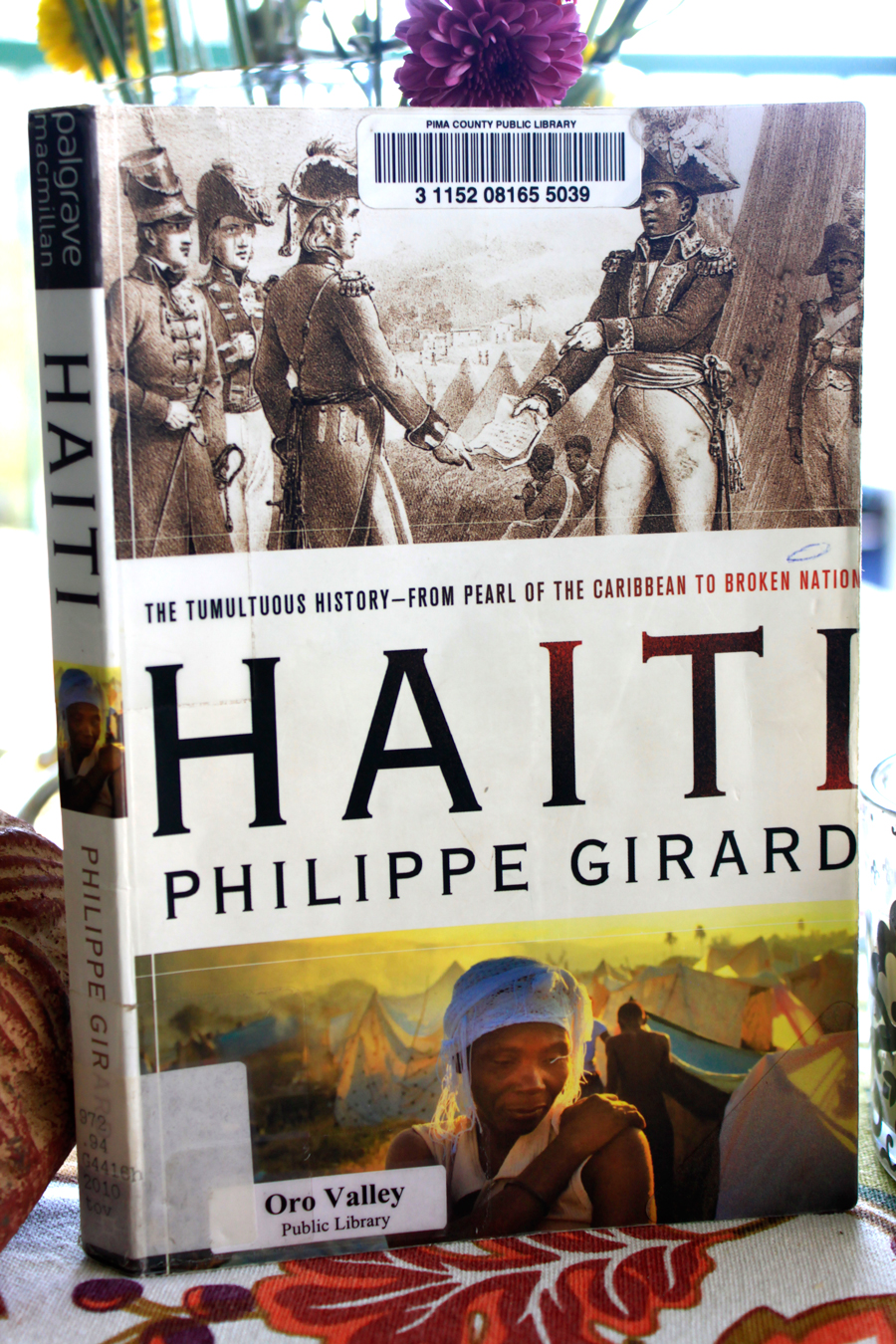
My current reading is by Philippe Girard, Haiti, The Tumultuous History – From Pearl of the Caribbean to Broken Nation.
 King of Dubbo