
There’s rarely anything we can do well in this life alone and researching a book is one of them. My number one assistant currently lives 7,907 miles away where she continues to dig up nuggets of gold for this story while enduring treatment for a pretty serious illness.
Yes she’s amazing. Thank you Sandra Smith for all your tireless efforts!!!
Anyway this morning when I woke up she had left me a remarkable piece of information to start my day. Well a couple really.
One was a document consisting of many newspaper clippings about Narcisse Muller, a Frenchmen who will feature in Negociant.
I know Narcisse arrived in Dubbo a young man who took up employment with Jean Serisier at the Dubbo Stores. Narcisse was raised in Wellington.
He must have been an ambitious young man too as he was one of the first elected alderman to council in his early 20s and was mayor on multiple occasions.
Muller Park, in north Dubbo is named after him and Sandra’s clippings today revealed some controversy which occurred during WW1, when being German was a very bad thing anywhere in the British Empire and a question was raised in the public forum on the wisdom of using a German’s name to label the park.
The accuser was from the Dulhunty clan no less.
Of course Narcisse and his blood line stretch back to France and Brussels so wrong on that count.
Something else struck me today more than anything in the letter to the editor defending Narcisse’s honour, poignantly written by JE Serisier, junior.
It’s a comment that strikes to the very heart of why I started writing this book in the first place.
It refers to the late Narcisse Muller, senior, as one of four Frenchmen, “viz., the late Hyeronimus, Martel, Serisier and Muller, who did so much to develop this very district in which his name is now being dishonored. By a strange coincidence a son of each of the above four Frenchmen carried the last survivor of the quartette of pioneers (Muller) to the grave.” J. E. Serisier, The Dubbo Liberal and Macquarie Advocate, Friday, June 9, 1916.
This French story is the foundation of Dubbo’s story and while yes, contribution to growth came from many corners and many cultures, in those early days, few could match the contribution of these particular men.
Imagine hearing French spoken on a daily basis on Macquarie Street as the norm in those early days – for me, it adds a dimension to the city’s story I find very appealing.
As any expatriate living away from their mother country, there must have always been a leaning of sorts, back in that direction, a curiosity to know what has changed, what is new, how are old friends, familiar places, a hanging on of one’s true, or just original, identity.
Their fathers participated in or were directly linked to legendary histories too as the Old World crumbled: The French Revolution, The Battle of Waterloo and Revolution again.
The French culture they brought to Nouvelle Galles du Sud (New South Wales) is mingled with Dubbo’s earliest memories too. I suppose they dreamed in French, would certainly have argued in French and probably appreciated good French cooking.
Negociant is definitely a tribute to the mergence of old French culture with one that was invented afresh by these men. Their families would have been brushed a little less with the same hue of French perspective and coloured perhaps a little more with what it means to be first generation citizens of Dubbo but their origins would have been very apparent.
You can take the pioneer out of France, but you can’t take France out of the pioneer.
Thanks again Sandra!!
Happy history hunting!
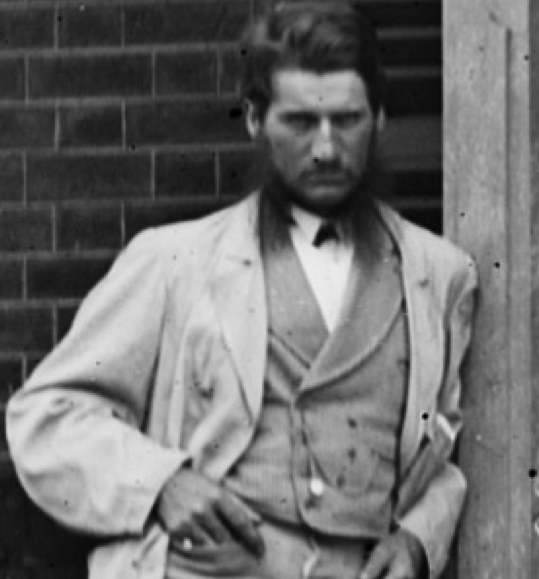
(Photo courtesy the State Library of New South Wales, Holtermann Collection – http://goo.gl/9oTwT3)
 King of Dubbo
Hello Yvette,
I came across your website the other day and noticed this entry.
You might be interested that in 1999 at the ‘do’ in Dubbo to celebrate the 150 years from the founding of Dubbo one of Narcisse Muller’s descendants sought me out at the dinner and said ‘On behalf of my family I would like to thank your family for standing up for us all those years ago’.
It was quite a moment.
Regards,
Richard
Dear Richard
I’m thrilled to hear you’ve found the site (please follow and comment often) and thank you for sharing that special moment. The more the team unearths the stronger that bond appears to be. I think of you often (I have so many questions) and also wondered if I could put a link here to Ce Soir Wine. You are certainly carrying on a family tradition. Looking forward to hearing your thoughts. Yvette
Hi Yvette,
I know that Narcisse Muller ran into anti-German feeling during the course of the Boer War and that this was when the Serisiers came out in his support…I wasn’t aware that this antipathy had carried on after that.
Cheers,
Richard
p.s. I’ll give you a link other than Ce Soir shortly.
Thank you again.
Hi Yvette,
A friend sent me the link to the ‘Wedding Bodice’ the other day.
I also have a photograph of the same couple (the older of the two boys on the balcony with JE and my great grandfather) many years later with some of their children.
It made me think of the samovar I own which was a gift to Constance by her children many years ago. My understanding is that Constance was a Bayliss from Sydney who were carriage makers in those days before horseless carriages. It also made me wonder whether the photographer Bayliss mentioned in your notes about Beaufoy Merlin was also somehow connected!
I’m sure I’ve seen somewhere or other the article in Town and Country about Eumalga from all those years but can’t seem to find it again now. Do you have acy you can send me? My email address is richard@serisier.co.uk
As a matter of interest I bottled my first vintage in Bordeaux just last week…Le Bout du Monde 2012. The magazine Le Point gave it a nice little note last April.
All the best,
Richard