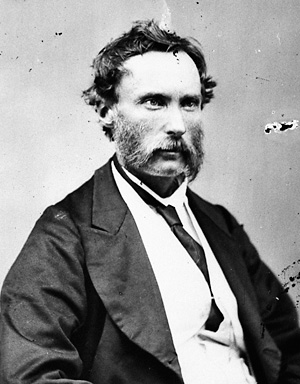
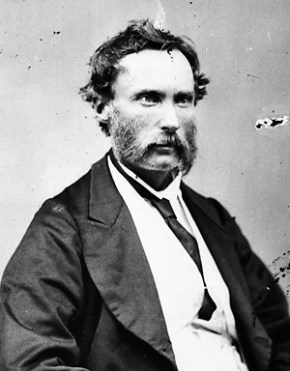
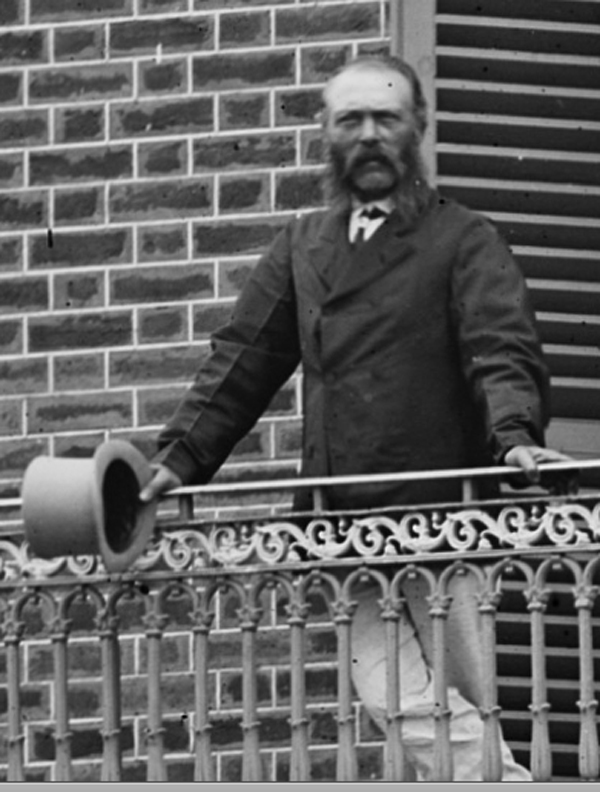
Beaufoy Merlin, Photographer, American and Australasian Photographic Company
A picture paints a thousand words, but it’s the things I don’t see in the following photo of the Jean Serisier’s Dubbo Stores that say infinitely more.
I first came across the iconic image hanging inside the front door of the gourmet deli, Newtown Providores, when it was located on Wingewarra Street, Dubbo. That was early days in my research and the picture naturally intrigued me.
The Dubbo Stores appears to be a very grand structure compared to the slab huts of other stores on the main street.
Jean Serisier stands proudly on the balcony with his sons, presumably, king of all he surveys, and, positioned around the street-level entrance are some non-descript workers but at least one of whom I believe is Narcisse Muller, a former mayor of Dubbo and one of the city’s many French fathers who started his career as a warehouseman with Jean.
The Dubbo Stores image also appears in the Local Studies archive at the Macquarie Regional Library (http://www.mrl.nsw.gov.au/LocalHeritage/dubbo-local-history) and is featured in the Dubbo Regional Museum (http://www.wpccdubbo.org.au/regional-museum.html) found at the Western Plains Cultural Centre (http://www.wpccdubbo.org.au/index.html).
Initially the lack of detail in the image was frustrating for someone of the digital age where the concept of “zoom” is practically a birth right.
I had to be content that at least here was one moment in Jean’s daily life preserved by the still-fledgling technology, glass plate photography.
Then I discovered the original was part of the digitized Holtermann Collection held in the State Library of New South Wales.
Here the thousand words behind the Dubbo Stores image began to tell their story in full.
The Holtermann Collection was commissioned by Bernhardt Holtermann, whose name is synonymous with the discovery at Hill End, on October 19, 1872 of one of the largest gold nuggets ever to be found.
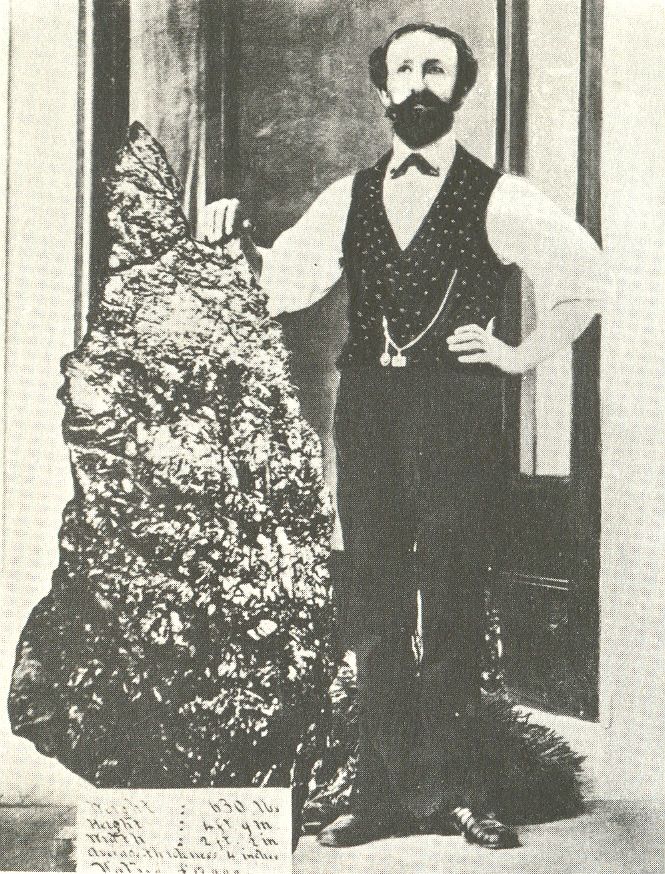
Beaufoy Merlin ….
… of the American and Australasian Photographic Company shot this now famous photograph of Holtermann and the nugget, which in fact is a composite of two images.
Holtermann encouraged Merlin to remain in Hill End, providing space for a photographic studio and begin the enormous photographic project, which included a door-to-door photographic record of the town’s occupants.
The extent of the collection is one of the reasons The Holtermann is one of the most important photographic collections from this period.
Another reason is the photographic technique used by Merlin, and his assistant, Charles Bayliss – the wet collodian glass plate.
The wet collodian plates produced the kind of extreme clarity we expect from our photographs today and in 1951 when 3,500 plate negatives were discovered in tact, a whole new perspective on 18th century was revealed.
Merlin favoured outdoor photography and produced many wide shots of street scenes capturing in great detail, people and objects.
In the online digitized Holtermann Collection the detail of the Dubbo Stores image goes from this…
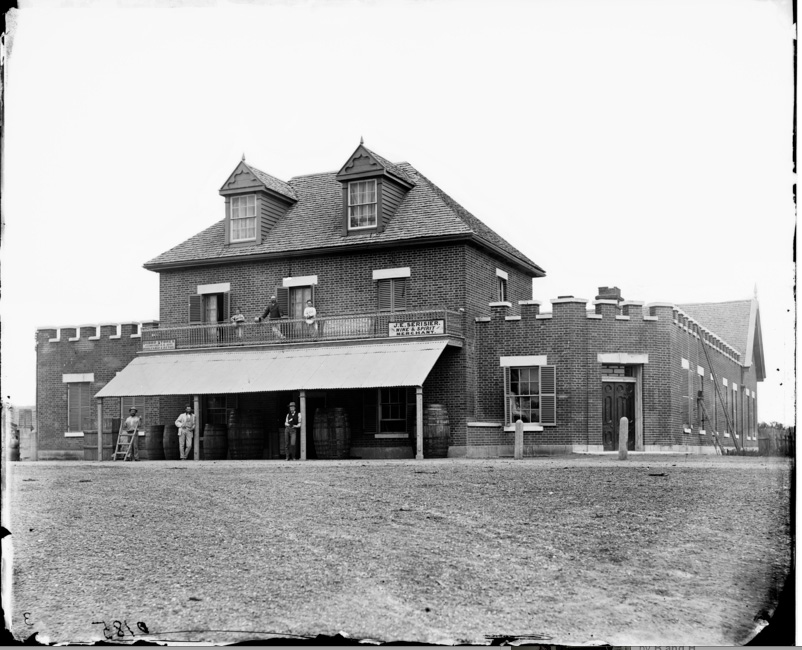
to this…
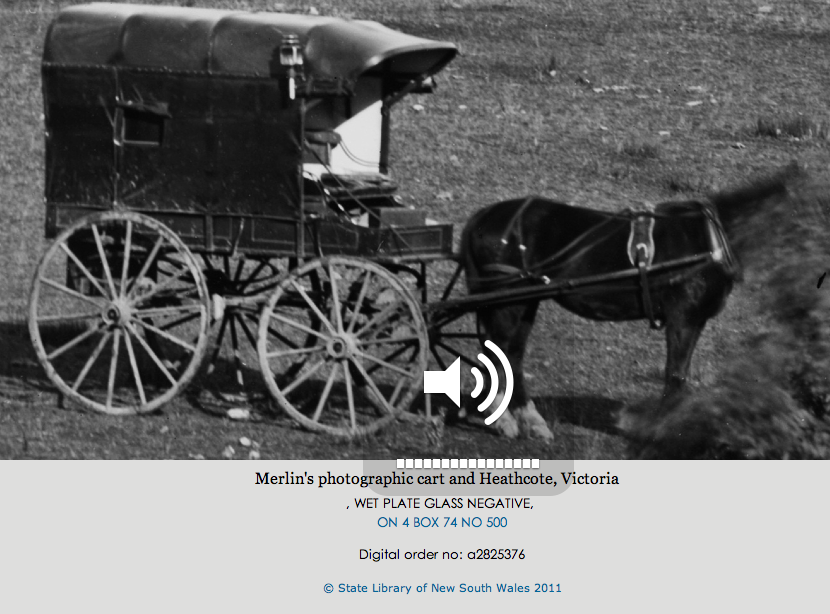
Astoundingly, Merlin traveled to Dubbo at a time when roads could hardly be considered conducive to carrying glass plates and all the necessary chemicals. It’s an amazing feat. His carriage, was in effect, a mobile dark room…
Despite the clues being right under my nose (!), needing to know when the Dubbo Stores image was shot has been a loose end I’ve tied off just today. I think I’ve narrowed it down at least to the month and year.
Reviewing the collection online again, lead me to another website with information on Merlin’s life and a vital clue to when he may have visited Dubbo.
The website referenced articles Merlin wrote for The Town and Country Journal about his photographic tour known as the Holtermann Exposition, which included Dubbo. There were three publication dates mentioned, in April, July and September of 1872.
I guessed, as Merlin’s travels took him to Orange and Bathurst, it stood to reason Dubbo might be last on the list being considerably further west, and the likely article about it would appear in the September edition
I was a bit wrong about that.
Here the odd habit of historians getting things wrong (bless us), the article reference was out by a whole year!!!!
On September 27, 1873 a feature article about Dubbo with a very detailed description of Eumalga, Jean Serisier’s vineyard, appeared in The Town and Country Journal with Beaufoy Merlin’s byline.
I have carried the exact same article in my own notes for well over a year but had not connected its author to the photo of the Dubbo Stores.
Then a new discovery. Merlin died on September 27, 1873, the same day as the story about Eumalga appeared in print!
The Town and Country Journal was a weekly publication and probably went to the printers up to a week before, and was laid out in the weeks prior to publication date, so he would certainly have submitted the story well ahead of his last day on Earth.
The return journey from Dubbo to Sydney was at least two weeks and certainly the production of the many photographs he took in Dubbo would have kept him in town for a week or two, putting him in Dubbo around mid August.
However, other sources confirmed that he had told Holtermann in April of ’73 he was too ill to continue the Exposition and would be sending Charles Bayliss in his place to complete the project.
Did Charles Bayliss take the photo of the Dubbo Stores? Was he ghost writing for an ailing Merlin?
While Bayliss is a respected photographer in his own right, I admit I was disappointed that it might have been him and not Merlin, directing Jean, his sons and employees for the Dubbo Stores photo on that day or spending quality time with Jean at Eumalga.
There is still that possibility, but if Merlin did write the article he had definitely been to Dubbo and Eumalga before April and its not really feasible he would go all that way without his camera gear!!!
Searching ‘Merlin Dubbo 1873’ in Trove for a clue prior to April resulted in a news column from Dubbo (which I’ve also had on file for some time, sigh) (http://goo.gl/VXLaUf) in The Evening News.
Dated March 3 … there in black and white, it reads:
“Mr. Merlin, who is the photographer for Holtermann’s exhibition [sic], has been taking views of the town and surrounding country, and his pictures have been pronounced by everyone as perfect gems of art.”
I have to be a little easy on myself as searching for this kind of information has been like building a puzzle with missing pieces even though some of the pieces are glaringly obvious what they are.
Given the incredibly complex nature of producing wet collodian plates (a video to prove it)…
…. suggests Merlin was in town for quite some time for opinions to be formed of his work, putting him in Dubbo for February ’73, and this is when I am certain the Dubbo Stores image was taken.
I assume he spent quite some time at Eumalga given his lengthy account but as yet no photographs from the 3,500-strong collection appear to be of the celebrated vineyard which is a pity.
I do wonder why six months lapsed before his article about Dubbo and Eumalga appeared in The Town and Country Journal. Possibly it was his illness that slowed him down, perhaps the organization of handing over the exposition to Bayliss meant he was distracted by that as well.
At any rate, those words on September 27, 1873, were the last of his to be published in Beaufoy Merlin’s lifetime.
Photo Credit: The Holtermann Collection, State Library of New South Wales, unless otherwise stated.
 King of Dubbo
Everything you’ve researched,,Yvette, always makes such intriguing reading. I enjoy your delving into the history of our Family. There’s just so much & yet you plough on with such determination. I wish there was more I could contribute.
William Serisier.